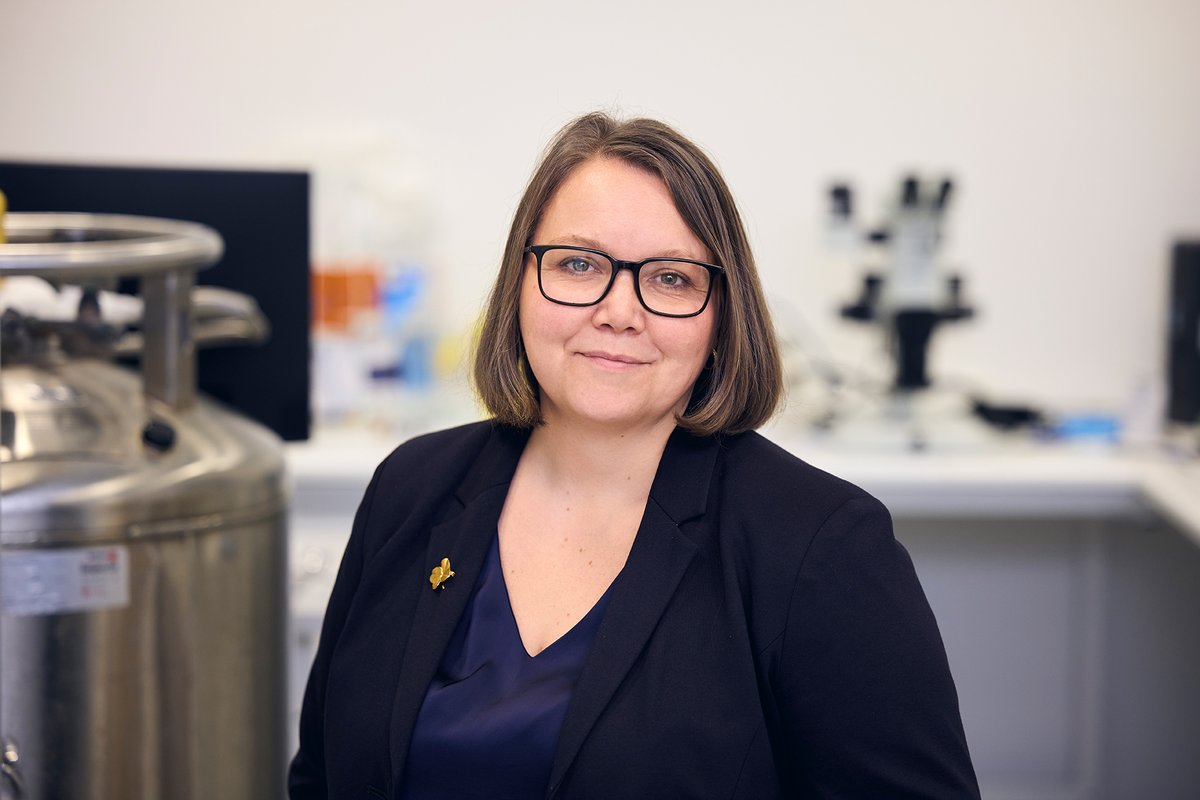
Professor Dorthe Ravnsbæk receives the Holst-Knudsen Research Talent Award
Leading the way to more sustainable batteries
When we hear the words “green transition”, we often think about wind turbines and solar panels. But behind the scenes, researchers are working on something that is just as important: better batteries. One of them is Professor Dorthe Ravnsbæk, who is one of the leading scientists in rechargeable battery materials. Now she has been awarded the 2026 Holst-Knudsen Research Talent Award.
By Ida Hammerich Nielson
You probably don’t think about it when you charge your mobile phone or start your electric car. But behind that action lies a vital technological question: Can we store energy in a better, cheaper and more sustainable way?
Dorthe Ravnsbæk wants to answer that question. As professor of materials chemistry, she is trying to develop new materials for rechargeable batteries – a technology that is vital to the green transition. If wind and solar power is to play a larger role in the future energy system, we need more effective ways of storing energy.
“Today, most rechargeable batteries are based on lithium, but lithium is a scarce resource extracted in relatively few parts of the world. We will need huge amounts of lithium if we are going to continue the current electrification process in which lithium-ion batteries play a central role. Therefore, we need to find alternatives to lithium, for instance sodium. Sea water is rich in sodium,” says Dorthe Ravnsbæk.
From the smallest detail to the big picture
In her research, Dorthe Ravnsbæk focusses on the contents of batteries – the ions, that is, the charged particles that move back and forth between electrodes. She and her research team use X-rays to study particle behaviour when batteries are charged and discharged. This is done in large research facilities in Europe, the US and Australia, capable of producing high-intensity X- or neutron radiation.
They use special equipment – developed in Dorthe Ravnsbæk’s labs – to study batteries at atomic level. And the aim is twofold: to understand the chemistry behind the materials and to develop solutions for cheaper and more sustainable large-scale energy storage. Therefore, Dorthe Ravnsbæk cooperates with companies like Topsoe A/S that produce catalysts and battery materials.
“I love basic research. But it is a good idea to be open to the commercial perspective – what the world actually needs and what questions people need answering. This makes basic research more focussed. Also, I find working with knowledge-intensive companies extremely inspiring,” says Dorthe Ravnsbæk.
Chemistry at eye level
Dorthe Ravnsbæk is celebrated for her ability to communicate complex chemical connections. She is able to make complex materials science relevant and easy to understand – inside as well as outside the lab. She gives lectures at upper secondary schools and Folkeuniversitetet, she has contributed to podcasts, and recently she wrote an article for Børneavisen.
“I find it extremely motivating to make complex things comprehensible. When people understand what we do, they usually become really excited – which is great.”
Professor Dorthe Ravnsbæk
- Born in 1983
- MSc in Chemistry (2009)
- PhD in Nanotechnology, Aarhus University (2011)
- Postdoc, Massachusetts Institute of Technology (MIT) in Boston (2012-2014)
- Assistant Professor (2015-2016) and Associate Professor (2016-2021) in Materials Chemistry, University of Southern Denmark
- Professor of Materials Chemistry, Aarhus University (2021)
- Center Leader, Center for Sustainable Energy Materials (CENSEMAT) (2025)
- Awards: Grundfos Prize (2020), H.C. Ørsted Research Award (2022), Elite Research Prize (2023)
- Member of the Royal Danish Academy of Sciences and Letters (2024)
About the Holst-Knudsen Research Talent Award
The Holst-Knudsen Research Talent Award is awarded in connection with the annual prize-giving at Aarhus University. The Award is conferred on two talented, young, Danish researchers employed at Aarhus University and carries a cash prize of DKK 100,000. The Award will be presented at the award ceremony in the Main Hall on Wednesday 27 May. Register for the event (link).
This year, the Award is conferred on Professor Dorthe Ravnsbæk and Professor Lars Wiuff Andersen.
The Rigmor and Carl Holst-Knudsen Award for Scientific Research will be conferred at the University’s annual celebration in September.